For decades, Attention Deficit Hyperactivity Disorder (ADHD) has been defined exactly as its name suggests: a deficit in attention and a surplus of hyperactivity. But what if we have been looking at the core of the problem the wrong way? What if the sudden lapses in cognitive performance aren’t about a lack of focus, but rather a lack of brain fuel?
A groundbreaking new perspective shifts the conversation entirely: ADHD may be less about a deficit of attention and more about an unstable supply of neural energy.
The EDHD Framework
This new way of thinking is the foundation of a theoretical framework called Energy Deficit Hyperactivity Disorder, or EDHD, proposed by neurobiologist Mohammad Dawood Rahimi from Freie Universität Berlin in a February 2026 paper published in Neuroscience & Biobehavioral Reviews.
Rahimi’s model aims to destigmatize ADHD by shifting the focus away from behavioral willpower and towards biological capacity. Instead of framing ADHD as an intrinsic executive dysfunction, EDHD reinterprets ADHD-related phenomena as expressions of constrained neural energy allocation.
According to this framework, people with ADHD do not lack the fundamental neurological machinery required to pay attention; rather, the energy supply needed to fuel those high-demand cognitive networks is simply unstable.
The Paradox of Hyperfocus vs. Exhaustion
If you have ADHD, you likely know the paradox well: you can effortlessly hyperfocus for hours on a highly stimulating project, yet you feel completely mentally exhausted by a mundane, five-minute chore. The EDHD framework explains this perfectly through the lens of energy regulation:
- Stimulating tasks momentarily optimize the brain’s energy allocation by providing necessary arousal feedback that maintains the metabolic supply.
- Mundane tasks rapidly drain your limited energy reserves without providing any of that necessary arousal feedback to replenish them.
Performance, therefore, isn’t based on your desire to do the task, it is entirely contingent on the energetic context of the task itself.
One of the most empowering aspects of Rahimi’s EDHD framework is how it reframes classic ADHD symptoms. The high-demand areas of the brain responsible for planning, self-regulation, and working memory require a continuous supply of cellular energy (ATP) to function properly. When environmental demands exceed the brain’s energetic recovery capacity, the system becomes progressively unstable.
In this state of energetic strain, behaviors traditionally pathologized as symptoms, like restlessness, fidgeting, impulsiveness, and task-switching, are actually intelligent, probabilistic compensatory strategies. They are state-dependent regulatory responses that the brain uses to stimulate arousal and temporarily stabilize energy levels when metabolic support is declining.
The EDHD model reveals that ADHD metabolic patterns actually have internal logic and functional integrity; they work reliably under the right conditions, such as during brief engagements, interest-driven tasks, and when given adequate recovery time.
The so-called deficit emerges because our modern institutional environments, workplaces, schools, and healthcare systems, are fundamentally optimized for neurotypical metabolic patterns. These neurotypical environments demand sustained attention over extended periods with minimal recovery time, creating a perpetual, structural mismatch for the ADHD brain. It is the equivalent of insisting a perfectly functional square peg is broken just because it doesn’t fit into a round hole.
Managing the Energy
Rahimi makes it clear that EDHD is a hypothesis-generating framework, not a new clinical diagnostic tool. However, viewing ADHD through the lens of energetic cost and recovery dynamics completely changes how we should approach managing it.
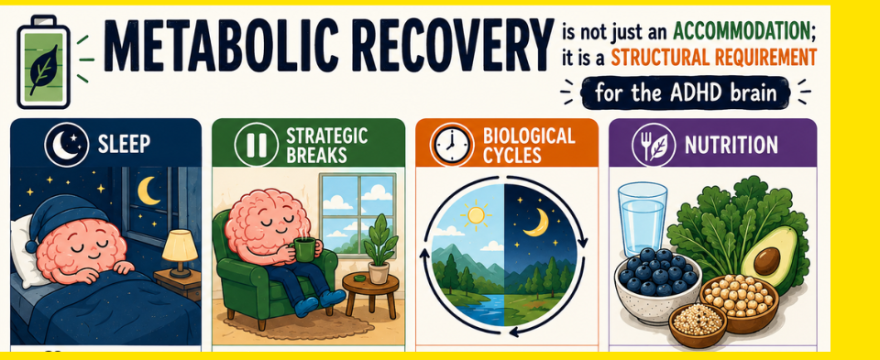
By recognizing executive functions as energetically expensive resources, the EDHD model tells us that ADHD management should shift away from questions of discipline and pivot toward the management of biological resources. Metabolic recovery, such as sleep, strategic breaks, biological cycles, and nutrition, is not just an accommodation; it is a structural requirement for the ADHD brain. I think it is the best plan of action for all our brains, regardless of an ADHD diagnosis.
Leave a Reply