President Donald Trump’s federal workforce cuts impacted the civil service pipeline that historically sustained the Black middle class, directly affecting Black women who serve as primary economic and social anchors for their families and communities.
Following Jim Crow, federal civil service served as one of the most reliable pathways into the middle class for Black Americans, offering steady pay, predictable schedules, pension plans, union representation, and narrower racial wage gaps than the private sector. Black workers make up approximately 18% to 18.6% of the overall federal workforce, well above their 12% to 14% share of the general U.S. labor market. In areas like the Washington, D.C. metropolitan region, federal employment built a thriving Black middle class with a median household income near $90,000. For generations, these positions allowed parents to fund higher education and pass stability down to their children; cutting these roles directly severed that vital intergenerational pipeline and interrupted multi-generational wealth transfer.
The administration’s massive workforce reductions and “Department of Government Efficiency” (DOGE) purges targeted Cabinet departments with the highest concentrations of Black employees, including the Department of Housing and Urban Development (36% Black workforce), Department of Education (36% Black workforce), Department of the Treasury (29% Black workforce), and Department of Veterans Affairs (25.2% Black workforce, accounting for over 121,000 Black workers). Under Executive Order 14173 and related directives, the administration ended government diversity programs, rescinded historical affirmative action requirements for federal contractors (such as Executive Order 11246), and targeted probationary employees for mass termination. Black women, who made up significant portions of DEI, administrative, and probationary roles, were often among the “first fired”, with reports showing that over 100,000 Black women exited the labor force or lost federal jobs in 2025 alone, suffering a drop in federal employment of more than 30%.
Because Black mothers are overwhelmingly the primary breadwinners paying family bills, abrupt job losses placed immediate financial strain on households, threatening home mortgages, child education, and basic security overnight. Psychologists describe the cold, abrupt nature of these terminations, such as key cards suddenly deactivated or sudden email notices, as a form of “institutional betrayal”, leaving former federal workers to endure severe psychological and physical stress, illness, hair loss, depression, and marital strain. The removal of Black women in federal roles eliminated significant unseen community labor, including informal caregiving, mentoring minority workers, and building community partnerships. Their departure wiped out institutional knowledge and civil rights enforcement mechanisms (such as the DHS Office for Civil Rights and Civil Liberties and the Department of Education’s Office for Civil Rights) that specifically protected marginalized groups.
So with all of this going on, I know it seems trite to still be encouraging clean eating. I know things are hard and eating 100% raw can sometimes feel like it comes with an unstated prerequisite: unlimited time, a generous grocery budget, and the mental bandwidth of someone with no income stressors or family demands. The first impulse is to make the raw gourmet dishes which of course you have to make from scratch and spend Sunday afternoons laboring over complex meal preps.
For most people balancing long work hours, family responsibilities, and tight budgets, that standard isn’t just unrealistic, it’s completely alienating.
When you finish a grueling day, your executive brain is offline. Decision fatigue, physical exhaustion, and financial stress make ordering takeout or grabbing cheap processed comfort food the path of least resistance. The good news is that optimal nutrition does not require gourmet recipes, expensive superfoods, or hours in the kitchen. By shifting from an “all-or-nothing” mindset to low-friction, high-yield strategies, you can nourish your body and brain even when time, money, and energy are at zero.
When you are burned out, traditional cooking, chopping, sautéing, monitoring, and cleaning up, feels impossible. The solution is assembly meals: combining 2 to 3 pre-prepped or shelf-stable whole foods that require zero knife work or stove monitoring. Combine black beans or chickpeas with quinoa, a handful of frozen corn or broccoli, and a spoonful of salsa or tahini sauce you can quickly whip up in a mini blender. Toss rolled oats, a spoonful of chia or flaxseeds, a handful of frozen berries, and plant milk into a jar. Shake it up and let it sit in the fridge overnight for an instant, high-fiber breakfast. Assembly meals eliminate decision fatigue while delivering the exact same fiber, complex carbohydrates, and micronutrients as a meal made entirely from scratch.
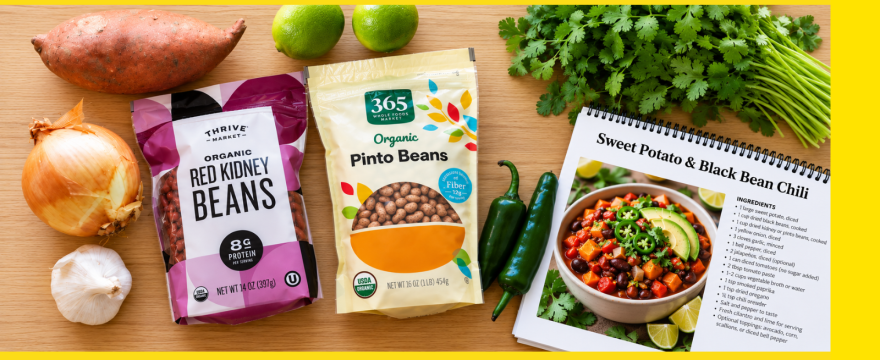
Dry beans cooked in a pressure cooker (like an Instant Pot) are the ultimate budget and batch-prep gamechanger for busy, stressed women. Buying dry beans in bulk costs a fraction of canned beans and they are healthier. With a modern pressure cooker, there is zero soaking required, simply throw dry black beans, pinto beans, or chickpeas into the pot with water, garlic, and spices, press start, and walk away. In 30 to 45 minutes of completely hands-off time, you have a massive batch of tender, creamy, low-sodium beans for the entire week. You can skip legumes and go for quinoa for max protein when even washing beans feels like too many steps. Frozen berries, broccoli, and cauliflower are flash-frozen at peak ripeness. They never spoil prematurely in the freezer, saving money and allowing you to use exactly what you need. I don’t even buy veggie broths. It is a nice-to-have for gut diversity but really is unnecessary. You can cook food in water and spices without spending money on broth.
Diets built on strict rules and long lists of “forbidden” foods consume immense mental energy, energy you don’t have when you’re stressed or burned out. Instead of attempting a radical diet overhaul, focus on crowding in one additional whole plant food into whatever you are already eating. Eating store-bought ramen? Toss in a handful of frozen peas or kale during the last minute of boiling. Also, there is a healthier ramen by Lotus Foods called Gluten-Free Millet & Brown Rice Ramen with Miso Soup available at Thrive Market. Having soup or pasta? Stir in half a cup of your pressure-cooked white beans or lentils for extra fiber and protein. Eating a simple wrap or grain bowl? Add a layer of pre-washed greens or a sprinkle of pumpkin seeds.
By adding nourishing elements to familiar, convenient foods, you upgrade your nutrient intake without adding stress or requiring extra kitchen skills.
Instead of buying expensive single-use superfoods, invest in budget-friendly bulk “toppers” that can be sprinkled onto almost any dish to instantly boost fiber, healthy fats, and minerals. Mix chia seeds, flaxseeds, and pumpkin seeds in a jar. Keep it on your counter and sprinkle a tablespoon over oatmeal, salads, or in smoothies. A simple jar of turmeric, black pepper, garlic powder, or cinnamon costs a few dollars and lasts for months, delivering powerful anti-inflammatory polyphenols to basic grains and beans.
The goal of healthy eating isn’t perfection or culinary mastery, it’s providing your cells, gut microbiome, and brain with the raw materials needed to function, recover, and stay resilient.
When life feels overwhelming, lower the bar. A meal consisting of pressure-cooked black beans, frozen corn, and an apple is a nutritional triumph. By removing guilt, leaning on smart pantry shortcuts, and keeping prep friction near zero, you can protect your health regardless of the turmoil happening around us.
Learn how I make raw foods fun, simple and quick. Join the January 2027 RawFoodMealPlanner’s 21-Day Challenge. Learn more here.
Leave a Reply