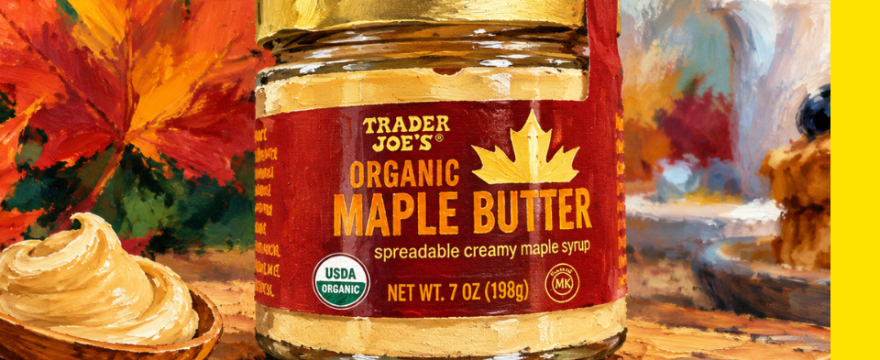
I found maple butter at Trader Joe’s, and the name alone made me curious. Maple syrup, I know. Butter, I know. But maple butter? Was I looking at a rich blend of the two, or something else entirely?
It is the kind of seasonal grocery find that feels like discovering liquid gold in the aisle. Rich, velvety, and full of deep caramel flavor, it sounds like something you would want to spread on practically everything. Then comes the question: Is Trader Joe’s maple butter healthy?
For the women I coach, that question usually reaches beyond the ingredient list. You want to enjoy your food. You also want enough energy to finish your workday, a clear head when someone needs your attention, and fewer afternoons when you feel exhausted and start searching for something sweet.
When you are over 40 and already noticing changes in your energy, memory, or concentration, even a small food decision can feel loaded. Do you have to give up another thing you enjoy? Does choosing a natural sweetener mean you can stop worrying about blood sugar?
Maple butter gives us a useful opportunity to look at those questions. Understanding what is in the jar, and how you eat it, can help you enjoy its autumnal sweetness with more intention.
What Exactly Is Maple Butter? Hint: It Is Not Dairy
Despite its name, traditional pure maple butter contains no dairy butter, no milk, and no added fat. You may also see it called maple cream or maple spread.
The ingredient behind that creamy texture is 100% pure Grade A maple syrup. That is it. The spreadable consistency comes from the way the syrup is heated, cooled, and stirred. So certainly not raw.
This is one of those moments when a food name can lead us to picture an entirely different product. “Butter” makes us think of dairy. “Cream” sounds like something whipped or poured from a carton. Here, those words describe the texture rather than the ingredients.
For someone eating a plant-based diet or avoiding dairy, that distinction matters. Traditional pure maple butter can fit those preferences. But dairy-free does not tell us everything we need to know about its effect on metabolic health.
How Maple Syrup Becomes Maple Butter
The transformation happens through sugar crystallization. It sounds technical, but the basic process is surprisingly easy to picture.
First, pure maple syrup is boiled to a precise high temperature, around 235°F, or 112°C. Heating concentrates the sugars as water evaporates.
Next, the hot syrup is transferred to an ice bath and cooled rapidly. At this stage, it is left undisturbed. Stirring too soon would interfere with the controlled process that creates the finished texture.
Once chilled, the syrup is stirred continuously for about 20 to 30 minutes. That mechanical agitation encourages the supersaturated sucrose solution to form millions of microscopic sugar crystals.
Those tiny crystals turn a clear amber liquid into an opaque, smooth spread with a consistency similar to peanut butter. Nothing has to be added to make it look creamy. The maple syrup itself changes form.
That is the detail I find fascinating: the jar looks like it contains something richer than syrup, but its texture comes from what happened to the sugar.
Check the ingredient label before assuming every maple butter is the same. Some recipes and commercial variations combine actual dairy butter with maple syrup and brown sugar. A product name alone cannot tell you whether you are buying pure maple spread or a compound butter.
Is Maple Butter Healthy? Start With the Nutritional Picture
Because pure maple butter comes directly from maple syrup, it retains trace amounts of minerals, including calcium and potassium, along with amino acids and organic acids.
Those naturally occurring components are part of what makes maple syrup different from a sweetener with no such compounds. Still, “contains minerals” and “supports my nutritional needs” are different questions. Trace amounts do not turn a concentrated sweetener into a major source of nourishment.
From a metabolic perspective, the central issue is its concentrated sugar content. Its sugar content is predominantly sucrose, approximately 88% to 99%. The creamy texture can make it easy to forget that you are still eating a concentrated sweetener.
Think about the difference between eating a piece of whole fruit and eating a spoonful of maple butter. Whole fruit comes with water and dietary fiber. Its sugars sit within a food structure that takes time to chew and digest.
Maple butter does not provide that same protective combination. It lacks fiber, and much of the syrup’s water has been removed during preparation. That means its natural origin does not prevent it from raising blood glucose quickly.
“Natural” Is Only Part of the Story
We often look for a reassuring word when deciding whether a food belongs in our kitchen: natural, organic, vegan, or made with one ingredient.
Those details can matter. They simply answer different questions. A single-ingredient food tells us about its composition. A dairy-free food tells us whether it contains dairy. Neither tells us how much to eat or how our blood sugar will respond.
You do not have to feel misled by the jar or guilty for enjoying it. You can appreciate a simple ingredient list while recognizing that maple butter works best as a sweet accent rather than something to eat freely by the spoonful.
That distinction leaves room for pleasure and an honest conversation about health.
Why Blood Sugar Matters for Women Over 40
As we age, maintaining insulin sensitivity becomes an important part of caring for metabolic health. Your body’s ability to manage glucose deserves attention, especially when energy, concentration, and hormonal symptoms are already concerns.
At least one in three adults lives with insulin resistance or prediabetes, often without obvious symptoms. That is a reminder that you cannot always tell what is happening metabolically just by how you look or whether you feel generally well.
For a woman whose afternoon fatigue is affecting her work, or whose brain fog is making conversations harder to follow, blood sugar is one part of the larger picture worth understanding. It does not explain every symptom. But the way you eat concentrated sugars can influence the demands you place on your body.
The Insulin Response: What Happens After Concentrated Sugar
When glucose enters your bloodstream, your pancreas releases insulin to help move it into cells. That is a normal process your body uses to manage energy.
When concentrated sugar produces a rapid rise in blood glucose, the pancreas has to respond to that incoming load. Repeated patterns of high glucose and elevated insulin can contribute to insulin resistance and strain on the pancreatic beta cells that produce insulin.
The issue is the repeated pattern. Consider how easily sweet foods can become scattered throughout a busy day: something sweet instead of breakfast, another bite between appointments, and a treat when you finally sit down.
Each choice may feel small. Looking at the whole day helps you see how often concentrated sugars are arriving without the fiber, protein, and other foods that could make the meal more balanced.
Energy, Mood, and the Afternoon Search for Sugar
A rapid glucose rise can be followed by a drop that leaves you feeling less steady. Stress responses, including cortisol release, can accompany those fluctuations. You may notice fatigue, anxiety, brain fog, or another strong craving for something sweet.
Picture the moment when you are trying to finish a task and suddenly feel as if your brain has stopped cooperating. A spoonful of something sweet seems like an easy answer. It tastes good, requires no preparation, and offers a quick lift.
If that becomes your regular response to feeling depleted, you may find yourself repeating the same cycle. The next craving can feel like a lack of discipline when what you need is a more supportive eating pattern.
For women whose work and relationships depend on being present, steady energy matters. You want to listen without losing the thread, complete a project without dragging yourself through it, and still have something left for your family.
Insulin and Hormonal Symptoms
There is also a hormonal connection. For women managing hormonal conditions like PMOS (Polyendocrine Metabolic Ovarian Syndrome / PCOS), elevated insulin can signal the ovaries to produce more androgens.
These hormones can contribute to symptoms such as stubborn breakouts, changes in hair growth, and abdominal weight retention. When you are dealing with those concerns, blood sugar management becomes relevant to more than the number on a glucose reading.
This does not mean one taste of maple butter causes a hormonal problem. It means that your everyday food patterns deserve consideration alongside the symptoms you are trying to manage.
So, Does Trader Joe’s Maple Butter Belong in Your Pantry?
Pure maple butter is a fascinating food: one ingredient, no dairy, and a creamy texture created through heat, cooling, and tiny sugar crystals. It is an interesting concept.
It is also a concentrated sweetener. Its trace minerals and natural origin do not remove the risks to blood sugar regulation.
For women over 40, that is the conversation I want us to have. You deserve food you enjoy and habits that support your ability to think clearly, work effectively, and show up for the people you love.
How could you make your meals more supportive of your energy?
Leave a Reply