
You notice that your mother keeps losing her train of thought. She is taking longer to organize her bills, and lately she seems less steady on her feet. Is this Alzheimer’s disease? Or could something else be happening?
It is understandable to think of Alzheimer’s first. But changes in thinking can have several causes, including changes in the brain’s blood vessels. One finding you may hear about is white matter disease, often described on a magnetic resonance imaging (MRI) report as white matter hyperintensities or chronic small vessel changes.
The distinction matters because the causes, common patterns of symptoms, and care plans can differ. It also has a crucial limitation: a person can have both vascular brain changes and Alzheimer’s disease. An MRI report or a symptom checklist cannot settle the question on its own.
Let’s walk through what these terms mean and what to discuss with a healthcare professional.
What is white matter disease?
White matter is the network of nerve fibers that connects areas of your brain. If brain regions are like people working together on a project, white matter helps their messages get from one person to another. The fibers are surrounded by a fatty insulating layer called myelin, which supports efficient communication.
White matter disease is a broad descriptive term for changes in this tissue. In older adults, the term often refers to white matter changes associated with disease in the brain’s small blood vessels. On some MRI sequences, affected areas look brighter than the surrounding tissue; radiologists call these areas white matter hyperintensities. White matter findings can have different causes, and their significance depends on their location, extent, age, symptoms, and medical history. They are not automatically a diagnosis of dementia. The National Institute on Aging describes small vessel disease as one of several vascular processes that can contribute to cognitive impairment.
Some people have white matter changes on MRI but continue to function well. In others, more substantial vascular injury can contribute to difficulty with thinking, movement, or daily life. When vascular changes cause meaningful cognitive problems, clinicians may use terms such as vascular cognitive impairment or, when the impairment is severe enough, vascular dementia. A finding on a scan and a clinical diagnosis are different things.
What is Alzheimer’s disease?
Alzheimer’s disease is a progressive brain disorder associated with changes in proteins called amyloid-beta and tau, along with damage to nerve cells and their connections. Difficulty learning and remembering new information is a common early pattern in typical Alzheimer’s disease. As the condition progresses, it can affect communication, judgment, behavior, and everyday functioning.
You may have seen Alzheimer’s described as a “gray matter disease” and white matter disease described as a “white matter disease.” That shorthand helps explain the initial comparison, but the brain does not divide neatly into two separate problems. Alzheimer’s can affect connections and white matter, while vascular injury can affect several brain structures. The more useful question is which processes are present and how much each is contributing to the person’s symptoms.
White matter disease vs. Alzheimer’s disease at a glance
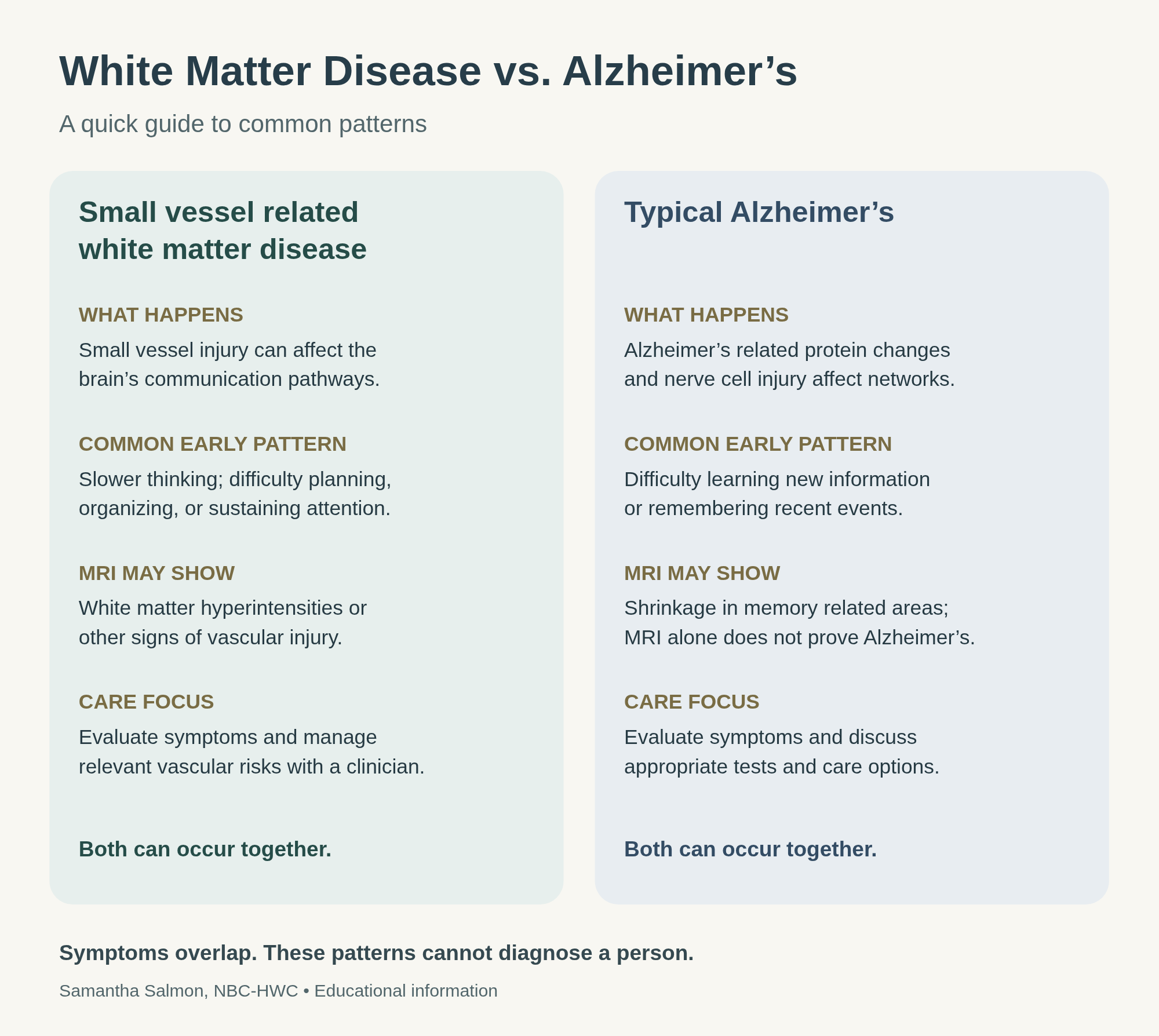
These are patterns, not rules. Vascular problems can affect memory, and Alzheimer’s can affect planning and attention. A person’s symptoms alone cannot reliably tell you which condition they have.
Difference 1: The usual source of the injury
White matter changes associated with cerebral small vessel disease involve the tiny vessels that supply the brain. Longstanding high blood pressure, diabetes, smoking, and other cardiovascular risk factors can increase the likelihood of vascular injury. The relationship is not a simple one cause, one outcome equation: someone can have these risks without developing dementia, and a scan finding may have more than one explanation.
Alzheimer’s disease involves a different central pathology. Amyloid plaques and tau tangles are characteristic brain changes, and the disease is associated with progressive damage to brain cells. This distinction does not mean blood vessel health is irrelevant to Alzheimer’s. Vascular risk and Alzheimer’s pathology can coexist and may both contribute to an individual’s difficulties.
Think of it this way: there can be a problem with the routes that carry messages, with the cells that use those messages, or with both.
Difference 2: The way thinking changes may first appear
One reason vascular cognitive impairment can be missed is that the first complaint may not sound like classic memory loss. Someone might say, “I know what I need to do, but it takes me forever to get started.” They may struggle to switch between tasks, keep track of several steps, or make decisions as quickly as before. Clinicians call many of these abilities executive functions. Slowed processing and problems with planning and attention are common in vascular cognitive impairment.
With typical Alzheimer’s disease, the early difficulty often centers on new learning. Someone may repeat a question after hearing the answer, forget a recent conversation, or have trouble recalling what happened yesterday. Losing a thought now and then is common; a repeated, growing change that interferes with daily life deserves evaluation.
Neither pattern is exclusive. Where an injury occurs matters. Vascular changes in one brain network may affect memory; Alzheimer’s can also affect decision making. If you are trying to describe a change to a clinician, specific examples are more useful than deciding in advance which diagnosis fits.
For instance: “She has paid her bills independently for years, but over the last six months she has missed three payments even though she knows when they are due.” That gives the clinician a clearer picture than “She seems forgetful.”
Difference 3: Walking, mood, and other changes
Some people with vascular cognitive impairment experience changes beyond memory and thinking. Walking may become slower or less steady. Mood and motivation may change as well. Depending on the affected brain pathways, bladder symptoms can sometimes occur. None of these signs, individually or together, prove that white matter disease is the cause; they may also reflect medication effects, orthopedic problems, sleep disruption, depression, or other health conditions.
Alzheimer’s can also involve changes in mood, motivation, and mobility over time. This is why a sharp divide such as “balance problems mean vascular disease” can be misleading. What matters clinically is the whole pattern: when changes began, whether they appeared gradually or suddenly, what else changed at the same time, and how they affect daily life.
If a person develops sudden trouble speaking, weakness, facial drooping, or abrupt confusion, seek emergency care immediately. Those symptoms need urgent assessment and should not be attributed to ordinary aging or a previously noted MRI finding.
Difference 4: What scans and tests can and cannot tell you
An MRI can help a clinician look for white matter hyperintensities, evidence of prior strokes, and other structural changes. But the phrase “white matter changes” on a report does not answer how much those findings explain a person’s symptoms. A clinician has to interpret the images alongside an examination, medical history, and cognitive testing.
MRI can also help assess brain shrinkage and rule out some other causes of symptoms. Shrinkage in certain memory-related areas may support suspicion of Alzheimer’s, but it is not the same as proving amyloid and tau pathology. When the diagnosis remains uncertain or a treatment decision requires clarification, a specialist may consider biomarker tests, such as selected blood tests, spinal fluid tests, or PET imaging, to look for evidence associated with Alzheimer’s disease. These tests have specific uses and limitations; they are interpreted in the context of the patient, not as a stand-alone answer to every memory concern.
A thoughtful evaluation may also look for other contributors: sleep problems, medication side effects, depression, infection, or other neurological conditions. Some causes of thinking difficulties can be addressed. That is one reason not to assume every new symptom is Alzheimer’s.
Difference 5: The care plan
When vascular brain changes are part of the picture, the care team will typically pay close attention to vascular health. That may include assessing and treating blood pressure, diabetes, and cholesterol as appropriate; discussing smoking cessation; supporting physical activity; and reviewing nutrition and other medical factors. These steps can lower relevant risks, though they cannot promise to erase existing white matter changes or prevent every case of dementia.
An Alzheimer’s diagnosis prompts its own care discussions: symptom management, safety, support for daily activities and caregivers, and whether the person qualifies for any disease targeted treatment. If vascular and Alzheimer’s changes coexist, both sides of the picture deserve attention.
As a health coach, I see value in the everyday supports that help people follow an individualized plan. A person may know they are supposed to monitor blood pressure or move more, yet need help finding a realistic routine amid work, caregiving, and fatigue. Coaching can support those habits and conversations with the medical team; it cannot determine which brain condition is present or replace treatment.
Can someone have both white matter disease and Alzheimer’s?
Yes. This is often called mixed dementia when brain changes from more than one disease contribute to dementia symptoms. Vascular changes commonly coexist with Alzheimer’s pathology, particularly in older adults. The National Institute on Aging reports that more than half of dementia cases show some damage to the brain’s vascular system, although the proportion attributable to each process differs by study and person.
Imagine someone whose memory problems fit Alzheimer’s but who also has substantial small vessel disease and slower walking. Treating that person as though there must be only one explanation could miss an important opportunity to address vascular risks and daily functioning.
There is a hopeful lesson here, but it needs to be stated carefully. Taking care of vascular health matters even if Alzheimer’s disease is also present. That does not mean all cognitive decline can be prevented through lifestyle choices. No one should be blamed for developing dementia.
What should you do if you notice changes?
If you or someone you love has persistent or worsening changes in memory, planning, mood, walking, or daily functioning, arrange a clinical evaluation. It helps to prepare a short timeline:
- Write down specific examples. What task became harder, and when did you first notice it?
- Note the pace of change. Did the change appear suddenly, follow a stroke, or develop gradually?
- Bring relevant information. Include medications, sleep concerns, medical conditions, and any prior brain imaging reports.
- Ask what the findings mean for this person. If an MRI mentions white matter changes, ask how the extent and location relate to symptoms and whether other causes need to be considered.
- Discuss a practical care plan. Ask which risks are worth addressing now, whether further cognitive testing or a specialist referral would help, and what support is available for daily life.
You do not have to translate an MRI report into a diagnosis by yourself. A careful evaluation can identify what is known, what remains uncertain, and which actions make sense next.
Frequently asked questions
Is white matter disease the same as dementia?
No. “White matter disease” commonly describes changes seen in the brain’s white matter, often on MRI. Dementia describes a level of cognitive impairment that interferes with independent daily functioning. A person can have MRI white matter changes without dementia. A clinician considers the imaging together with symptoms and function.
Are white spots on an MRI always Alzheimer’s?
No. White matter hyperintensities are often discussed in connection with small vessel disease, and they can have other explanations. An MRI finding alone cannot establish or exclude Alzheimer’s. Ask the ordering clinician how the finding fits your history and symptoms.
Can white matter disease cause memory loss?
It can contribute to memory difficulties, although slowed thinking, attention, and planning problems may be more prominent in some people. The specific pattern varies, and memory problems can have multiple causes.
Can white matter disease be reversed?
An MRI change should not be assumed to disappear with lifestyle changes. Managing vascular risk factors may help protect future brain health and is an important part of care. The outlook depends on the underlying cause, the extent of injury, and the individual’s health. Discuss treatment goals with a clinician.
Which condition is worse?
There is no universal answer. The impact of either condition depends on severity, other health conditions, the brain regions involved, and the support a person receives. They may also occur together. A useful next question is, “What is contributing to these changes, and what can we do now?”
Leave a Reply