Metabolic psychiatry is an emerging clinical and research field that explores the fundamental connection between metabolism and brain health. It operates on the revolutionary framework that mental disorders are essentially metabolic disorders of the brain. The term “metabolic psychiatry” was coined by Dr. Shebani Sethi, who established the first clinical research program for the field at Stanford University.
The field builds upon extensive evidence demonstrating that systemic metabolic abnormalities, such as insulin resistance, mitochondrial dysfunction, lipid dysregulation, and chronic inflammation, play a significant pathophysiological role in mental illnesses. Because the brain is highly energy-demanding, disruptions in its metabolic function can directly alter neural signaling, cognition, and emotional regulation. These shared brain-body disruptions help explain why some patients experience limited relief from standard psychiatric medications and face much higher risks for medical issues like obesity, cardiovascular disease, and type 2 diabetes.
To address these root causes, metabolic psychiatry utilizes metabolism-based interventions to simultaneously improve mental and physical health. Key treatment strategies include:
- Ketogenic Metabolic Therapy: A major focus of the field is the medical ketogenic diet (a high-fat, moderate-protein, very low-carbohydrate diet). This diet shifts the brain’s fuel source from glucose to ketones. Ketones provide a highly efficient energy source that bypasses glucose hypometabolism (a common deficit in psychiatric conditions), enhances mitochondrial energy production, reduces oxidative stress and neuroinflammation, and rebalances critical neurotransmitters. Pilot trials have shown that ketogenic diets can reverse metabolic syndrome while driving clinically meaningful improvements in conditions like schizophrenia, bipolar disorder, and treatment-resistant depression. Given that keto has been shown in research to not have good outcomes in the long term and the plant based diet is a longevity diet, I think the healthier version of keto would be a plant based one. The alternative is to focus on the areas of commonality between the two which are the elimination of ultra processed foods and the consumption of non-starchy vegetables.
- Metabolic Medications: The field also investigates the psychiatric benefits of pharmaceuticals typically used for metabolic diseases, including metformin, GLP-1 receptor agonists (e.g., liraglutide, semaglutide), and pioglitazone. Evidence suggests these medications can improve brain insulin signaling, reduce neuroinflammation, and improve mood and cognitive symptoms across various psychiatric disorders.
By integrating the brain and body into a unified model of care, metabolic psychiatry offers a new, holistic framework for treating a wide spectrum of conditions, including major depression, anxiety, bipolar disorder, schizophrenia, anorexia, and ADHD. Along with Dr. Sethi, prominent pioneers advancing this field include Harvard psychiatrist Dr. Christopher Palmer, who developed the comprehensive “brain energy theory” of mental illness, and Dr. Georgia Ede, an internationally recognized expert in nutritional psychiatry.
There’s a growing conversation in mental health that doesn’t always move in one direction, and that tension is worth paying attention to. On one side, you have voices like Georgia Ede, a Harvard-trained psychiatrist who is promoting ketogenic approaches for brain health. Her work stands out precisely because it pushes against the science for longevity.
At the same time, there is a substantial group of equally credentialed experts, many with deep ties to Harvard, who arrive at a very different conclusion. Leaders like Walter Willett argue that the strongest evidence supports a predominantly plant-based diet for long-term health and longevity. Dean Ornish has gone even further, demonstrating through clinical research that comprehensive lifestyle changes, including a whole-food, plant-based diet, can not only prevent but potentially reverse chronic diseases.
In fact, Dr. Ornish’s recent randomized controlled trial offers a compelling example of what this approach can look like in practice. Participants with early-stage cognitive decline followed a structured, drug-free lifestyle program built around four pillars: a minimally processed plant-based diet, daily exercise, stress management practices, and consistent social support. Over just 20 weeks, the results were striking. While the control group experienced continued decline, the majority of those in the intervention group improved or stabilized cognitively. Some regained abilities they thought were lost, like reading with comprehension or managing finances, alongside measurable improvements in biological markers linked to Alzheimer’s disease.
What’s especially powerful is that these changes weren’t isolated. Improvements showed up across multiple systems, from brain function to the gut microbiome, highlighting how deeply interconnected metabolic health is with cognitive outcomes. And perhaps most telling, the study revealed a clear “dose-response” effect: the more consistently participants followed the lifestyle, the greater their improvement.
This perspective is echoed by others in the field. Robert Ostfeld emphasizes plant-based nutrition as a way to counteract the damage of the Western diet, while Michelle Loy and David Ludwig advocate for whole-food approaches that prioritize plants, fiber, and sustainable eating patterns. Even within varying dietary philosophies, there’s a shared recognition: food quality and metabolic health are central to brain function.
So when you step back, what emerges isn’t a single answer, but a pattern. A large and highly trained group of experts, approaching the problem from different angles, continues to point toward the same foundational truth: the way we fuel our bodies profoundly shapes how our brains function.
And that’s where the conversation naturally begins to shift.
Because if metabolic health plays such a central role in brain health, then the next question becomes: what specific dietary factors are quietly driving dysfunction beneath the surface?
That’s where AGEs come in.
The Formation of AGEs: Sugar, Protein, and Heat
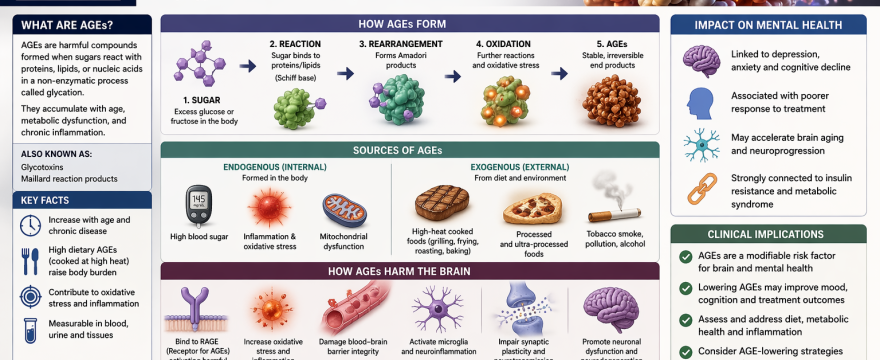
Advanced glycation end-products, or AGEs, are harmful substances that form when sugar sticks to important parts of your body like proteins and fats, basically “damaging” them over time. This happens through a natural chemical process called the Maillard reaction, where sugar molecules attach to these structures and go through several changes until they become permanent and hard to break down. Some sugars, like fructose, are especially reactive and can create AGEs even faster than glucose. While your body can form AGEs slowly on its own, a big source actually comes from the food you eat, especially when food is cooked at high temperatures. Methods like grilling, frying, roasting, and baking speed up this reaction a lot, which is why heavily cooked foods, particularly animal products high in fat and protein, tend to contain more AGEs.
Impact on Brain Aging, Inflammation, and Cognition
When AGEs build up in the body, they can quietly drive long-term inflammation, which is one of the key reasons they’re linked to brain diseases like Alzheimer’s. They do this by attaching to a special receptor in the body called RAGE, which is found on brain cells. Once AGEs bind to this receptor, it basically flips on an internal “alarm system” that tells the body to release inflammatory chemicals and harmful molecules that damage cells. This creates a cycle where inflammation keeps feeding more inflammation. In the brain, AGEs can also directly damage important proteins like amyloid and tau, causing them to clump together, something strongly associated with Alzheimer’s disease. On top of that, this process makes it harder for the brain to clear out waste, allowing these toxic proteins to build up even more. Over time, the constant stress and inflammation can weaken the brain’s protective barrier, disrupt energy production in brain cells, and eventually lead to the death of those cells. That’s why higher levels of AGEs in the body are linked to faster memory decline and a higher risk of dementia.
Practical Ways to Reduce AGEs Through Food Choices
Because 10-30% of circulating AGEs in the blood are absorbed directly from the diet, making targeted food choices is a highly effective way to mitigate their damage.
- Alter Your Cooking Methods
To drastically cut your exogenous AGE intake, shift away from dry, high-heat cooking. Instead, utilize cooking methods that rely on lower temperatures and high moisture, such as boiling, steaming, poaching, or stewing. You really cannot get lower temps than a raw food diet.
- Limit Ultra-Processed Foods and Animal Fats
Ultra-processed foods (which make up a large portion of the standard Western diet) are major sources of dietary AGEs. Reduce your intake of highly processed items, deep-fried foods, and animal-derived foods that are high in fat and protein, as these are the most prone to AGE generation during processing. Emphasize a diet rich in raw or steamed vegetables, whole grains, and low-glycemic foods. Evidence shows that adopting a low-fat vegan diet can reduce daily AGE intake by over 73%.
- Cut Back on Added Fructose
Because of its hyper-reactivity, consuming high levels of fructose, particularly in the form of high-fructose corn syrup found in sodas and sweetened fruit drinks, can lead to rapid AGE formation in the intestines and liver. Isocaloric restriction of fructose has been shown to improve insulin resistance and lipid profiles in just over a week.
- Incorporate Polyphenol-Rich Foods
Polyphenols are natural plant compounds that act as powerful anti-glycation agents. They neutralize reactive oxygen species, chelate metals that catalyze glycation, and actively trap the highly reactive intermediate molecules (like methylglyoxal) before they can form permanent AGEs. Practical ways to add them include:
- Drinking Tea: Green tea is rich in EGCG, a flavonoid with proven abilities to trap reactive dicarbonyl species and inhibit carbonyl stress.
- Using Spices: Cinnamon and ginger contain active components (like procyanidin B2, 6-shogaol, and 6-gingerol) that inhibit AGE formation.
- Consuming Grapes and Berries: Resveratrol, predominantly found in grape skins and seeds, protects against AGE-induced oxidative stress, helps downregulate RAGE expression, and limits smooth muscle proliferation in blood vessels.
To circle back, 10-30% of circulating AGEs in the blood are absorbed directly from the diet. Most of the AGEs in your body, about 70–90%, are actually made inside you, not just from the food you eat. These are called endogenous AGEs, and they form naturally during everyday processes in your body. The main way this happens is through the Maillard reaction, where sugars like glucose or fructose slowly attach to proteins and fats, causing damage over time. AGEs can also form through other processes, like when your body breaks down fats under stress, creating harmful byproducts that damage proteins. While this is a normal part of aging, certain factors can speed it up a lot. For example, high blood sugar levels, especially from diets high in saturated fat and refined sugar, give your body more sugar to fuel this process and drive up insulin resistance. Also, proteins that stay in your body longer, like collagen in your skin, are more likely to build up damage over time. On top of that, oxidative stress (which is like internal “rusting” caused by harmful molecules) can accelerate AGE formation even more. So while your body naturally makes AGEs, things like poor blood sugar control, aging, and high stress levels can cause them to build up faster and lead to more damage.
While we can’t stop the natural aging process, we do have a powerful say in how quickly this kind of damage builds up in the body. By keeping blood sugar stable and reducing stress through intentional diet and lifestyle choices, we can slow down the formation of AGEs and protect our brain health over time. This is exactly the approach I guide you through in my Brain Health Breakthrough Coaching Program, helping you take what can feel like a complex science and turn it into simple, daily habits that support real cognitive change. If you want to see how this works step by step, you can click here to watch the full webinar where I walk you through the entire framework. It closely follows the same lifestyle-based approach used by Dr Dean Ornish, which is already showing promising results in helping people improve and even reverse early cognitive decline.
Leave a Reply